
Compliance
Commercial Vehicle Documents: A Compliance Checklist
By ATTPL Fleet · · 3 min read
Documents every commercial vehicle and driver in India should carry and keep valid: RC, permit, fitness, insurance, PUC, licence and e-way bill.

Why paperwork matters on the road
A truck with a valid load and a skilled driver can still lose a day — or more — at a checkpoint if one document has expired. Penalties, detention of the vehicle and delayed deliveries hurt both the transporter and the customer. Keeping documents valid and easy to show is one of the simplest ways to protect service reliability.
Rules are set by the Motor Vehicles Act and the rules made under it, along with state transport department requirements and GST rules for goods movement. Requirements can change, so treat this checklist as a starting point and confirm current rules with the transport authority.
Vehicle documents
- Registration Certificate (RC) of the vehicle.
- Valid permit for the route — national permit or state permit as applicable.
- Fitness certificate for transport vehicles, renewed as required.
- Insurance policy — at least third-party cover as required by law; comprehensive cover is advisable.
- Pollution Under Control (PUC) certificate.
- Road tax receipts and any state-specific tax documents.
Many documents can be carried digitally through official apps such as DigiLocker and mParivahan, which are accepted in place of physical copies in many situations.
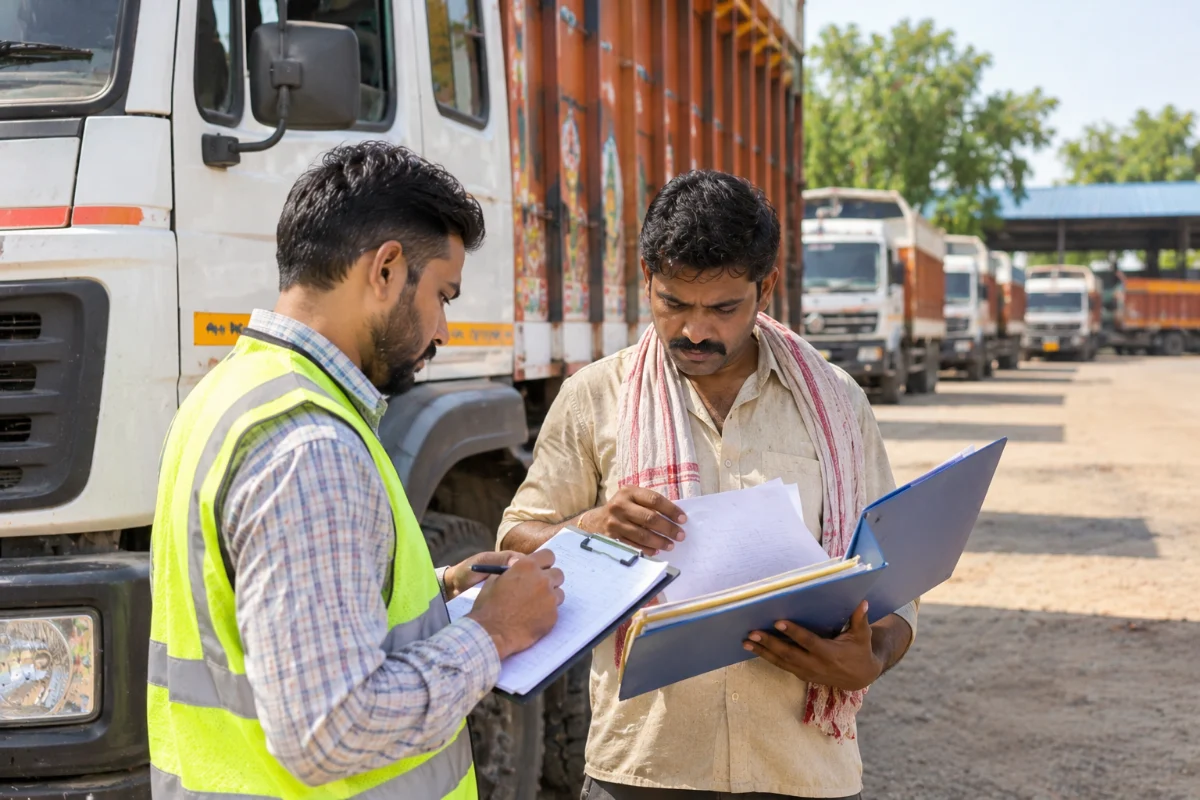
Driver documents
- Valid driving licence with the correct transport vehicle endorsement.
- Identity proof and employer authorisation where required.
- Records of training, especially for hazardous goods, which need special certification.
- Emergency contact details and company helpline number.
Our driver safety training checklist explains the skills side. HR documents, attendance and salary records for drivers can be kept in one place with ATTPL WorkforceOS.
Goods and trip documents
For goods movement, the consignment note or lorry receipt, the tax invoice or delivery challan and, where the value and distance require it, the e-way bill must travel with the goods. Errors in vehicle numbers or validity periods on e-way bills are a common cause of detention. See our detailed e-way bill checklist. For over-dimensional or special cargo, additional permissions apply, explained in our ODC transport checklist.
Build a simple renewal system
Most problems come not from missing documents but from expired ones. A renewal system prevents this:
- Keep a register of every vehicle and driver document with its expiry date.
- Set reminders 30 and 7 days before expiry.
- Assign one person to handle renewals and update the register.
- Keep scanned copies in a shared folder and digital copies on the driver's phone.
- Audit a few vehicles every month at random.
Fleet software can automate these alerts; see our fleet management software guide. Insurance claims and disputes after an accident may need legal support from ATTPL Legal, and vehicle insurance and finance questions are covered by ATTPL Finance.
Common reasons vehicles get held up
Checkpoint delays usually follow a familiar pattern. A permit that does not cover the state being entered, an insurance policy that lapsed a day earlier, a PUC certificate nobody remembered, or an e-way bill generated with an old vehicle number after a last-minute vehicle change. Each of these is preventable with a clear process and one responsible person.
- Vehicle changed after the e-way bill was generated, without updating Part B.
- Permit or route not covering the destination state.
- Insurance or fitness expired during a long trip.
- Driver's licence lacking the right vehicle class endorsement.
- Documents only on paper in the office, not with the driver.
Train supervisors and drivers on these points and review every detention incident to fix the root cause.
Checklist before every trip
Before a vehicle leaves the yard, the supervisor should confirm that the RC, permit, fitness, insurance and PUC are valid for the whole trip duration, that the driver's licence is valid and suitable, and that the goods documents match the load and vehicle number. Two minutes at the gate can save a full day at a checkpoint. For reliable, compliant transport for your business, contact ATTPL Fleet.
Frequently asked questions
Are digital copies of vehicle documents valid?
Documents stored in official apps such as DigiLocker and mParivahan are accepted in many situations. Carry originals or valid digital copies as per current rules.
How often is a fitness certificate renewed for commercial vehicles?
It depends on the vehicle's age and the applicable rules. Check the current renewal period with the transport department.
What happens if an e-way bill has the wrong vehicle number?
The goods and vehicle may be detained and penalties may apply. Update the vehicle details on the e-way bill portal before the trip.
Sources and further reading
General information only. Rules and requirements change; confirm current requirements with the transport department.